



One researcher stated that the mysterious Book of Revelation in the Bible deliberately uses language and terminology found in Roman curse texts.
According to a new study, the mysterious language of the Book of Revelation (famous for its bizarre imagery, including a seven-headed red beast and a female figure representing the evils of Babylon) was intentionally made to resemble the language used in the ancient Roman “curse table.”
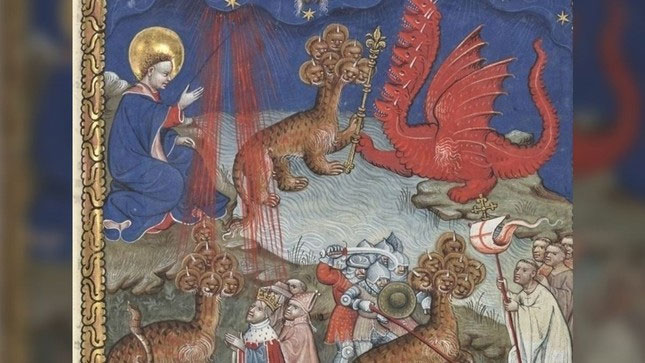
The strange imagery in the Book of Revelation includes the prophet (on the left) and a seven-headed red beast or dragon that may symbolize Satan. This image is from Apocalypse Flamande, a manuscript of the Book of Revelation created in the 15th century.
Research suggests that the Book of Revelation, part of the Bible, written in the late first century AD, attempted to distinguish religion from the paganism of the Roman Empire by expressing its message in a different way.
Michael Hölscher, a researcher in the biblical studies department at Johannes Gutenberg University in Mainz, Germany, is conducting a research project on the similarities between the Book of Revelation and Roman curse tablets for the German National Research Agency (DFG).
He cited a key example from the Book of Revelation where God is spoken of “binding” and “releasing” Satan. A similar term was used in Roman curse texts, also known as “defixiones” —Latin for “binding”—meaning to compel the victim to perform a certain action.
Another example is the Book of Revelation, which describes the enemy as curse boards. For instance, Revelation chapter 13 prophesies that “the mark of the beast” will be placed upon all people, regardless of wealth or poverty, freedom or slavery…
Apocalypse
The Book of Revelation (also known as Revelation for John, or John’s End Times) is interpreted by most modern scholars as an attempt to prophesy the end times and the return of Jesus Christ.
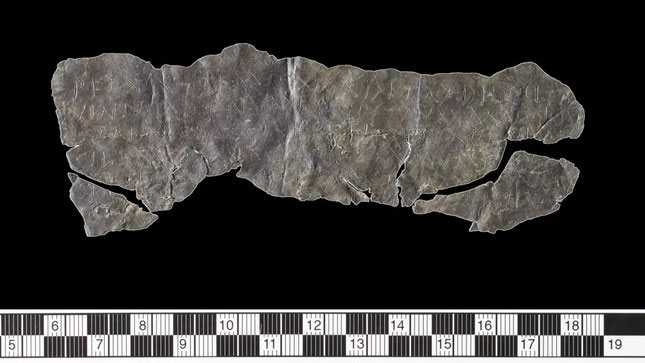
The curse plaque is made of lead.
According to the Book of Revelation, Gentiles will be cast into hell, while Christians will ascend to heaven in the next life.
According to scholar Bart Ehrman, the authorship of the Book of Revelation is believed to have been attributed to a man named John of Patmos, who wrote it around 96 AD after witnessing or hearing about the Roman destruction of Jerusalem in 70 AD.
The Book of Revelation depicts the end times with imagery familiar to early Christians. It also introduces the “number of the beast ,” possibly a reference to the Roman emperor Nero, whose name in Hebrew is “666” and who was notorious for his brutal persecution of Christians.
Hölscher noted that not only the wording in the Book of Revelation was inspired by Roman curse tablets, but also the actions themselves. For example, an angel throwing a large stone to destroy Babylon was a kind of curse ritual.
Hölscher notes that the influence of curse tablets is also evident in linguistic elements stemming from the practice of writing curses. For example, figures associated with the gods in the Book of Revelation often wrote the names of those gods on their bodies—for instance, followers of the beast wore the beast’s name or number on their hands or foreheads.
Cursed tablets have been found throughout the former Roman Empire, from Britain to Egypt, and were widely circulated, even though they were considered black magic and forbidden by Roman law.
These included curses intended to harm enemies, often inscribed on a thin lead plate, which was then placed in a location where only the gods could see it.
However, the similarities between the curse tablets and the Book of Revelation have not convinced all experts and remain controversial.