



Jupiter is one of the giant gas planets in the Solar System; it is many times larger than Earth and surrounded by a thick layer of gas. Therefore, traversing Jupiter is not easy.
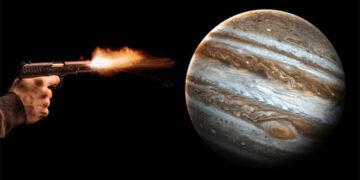
Jupiter, Saturn, Uranus, and Neptune are four gas giants in the Solar System. They have thick atmospheres, unlike Earth or any other rocky planet in the system. Many people wonder if traveling through them would be like passing through a cloud, or if it’s possible to shoot a bullet through Jupiter. The answer in most cases is no.
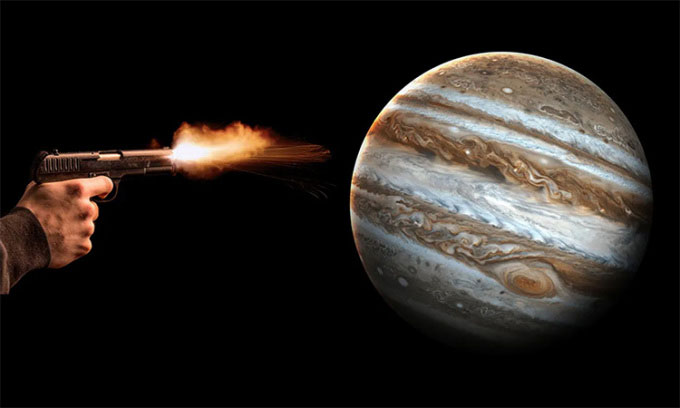
Jupiter is not composed entirely of gas and is not easily penetrated by bullets. (Image: Vadim Sadovski/Frunze Anton Nikolaevich/IFLScience)
Jupiter, like other gas planets, isn’t just gas . Jupiter has a core and a mantle beneath its atmosphere. The planet’s solid core has a vaguely defined boundary, blending with the upper mantle—a vast ocean of liquid metallic hydrogen. This ocean is estimated to be tens of thousands of kilometers deep.
Metallic hydrogen is a special state of hydrogen at high pressure. This gas liquefies and becomes similar to mercury, but is only 60% as dense as water and is subjected to immense pressure. Currently, no human technology can withstand that level. As for the core, experts still need to conduct more precise measurements, but its radius could be up to half the radius of the entire planet. Therefore, it is impossible for a projectile to penetrate Jupiter’s core.
NASA’s Juno, Galileo, and Cassini spacecraft have provided scientists with information about the outer layers of Jupiter’s atmosphere. So, is it possible to fire a bullet through these layers?
According to simple estimates, to maintain an orbit around Jupiter at the edge of the atmosphere, the object would have to travel at a speed of 42.5 km per second. The fastest commercial bullet would still be 30 times slower. Furthermore, if it passed through Jupiter, the object would be incinerated beforehand because the temperature in the uppermost layer of the atmosphere reaches 630 degrees Celsius.
The temperature then dropped, but wind speed and pressure increased. During its deliberate “suicide” mission in 2003, the Galileo spacecraft survived for about 58 minutes as it plunged into Jupiter’s atmosphere, descending to a depth of 156 km, enduring a pressure of 23 atm and a temperature of 153 degrees Celsius.
An average bullet would be stopped by a layer of water several meters thick. Therefore, unless using an extremely powerful gun and firing at a very shallow angle, the bullet would not be able to penetrate Jupiter. The planet has been struck by objects moving faster than bullets. In 1994, the Shoemaker-Levy 9 comet crashed into Jupiter at a speed of 61.4 km per second. It left few traces in the atmosphere for a short time, but the particles ejected from the collision remain. Researchers have even used them to measure wind speeds in Jupiter’s stratosphere.