



Since their birth on Earth, humans have continuously developed, eventually evolving to become the most advanced creatures on Earth, understanding and exploring almost everything in this world. We have progressed so much that, whether it’s flying in the sky or on the ground, running or swimming in the sea, humans can now probably know a thing or two. Even space beyond Earth is now a subject of human exploration.
However, ultimately, human discovery is limited. In today’s society, many scientific and technological tools can indeed be used to explore the past and present, but human capabilities are also limited. We are not able to travel through time and the future, so very little information about the past and future is known. For example, in human history, there have been three strange natural disasters whose causes were unknown to people at the time, and which people today still cannot unravel.
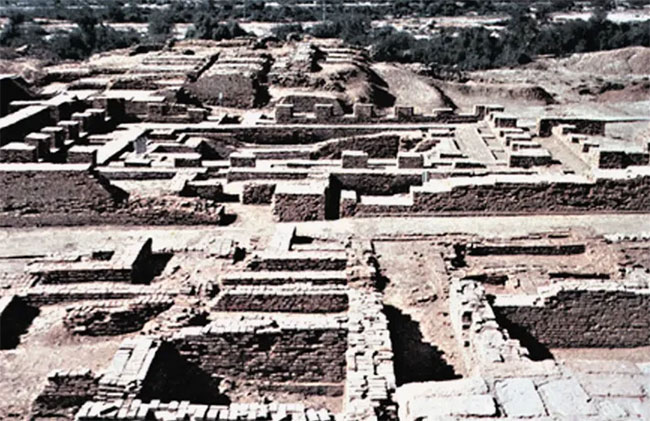
The site of this natural disaster is also known as “Mohenjo-daro”.
After millions of years of development, humankind has evolved into the advanced species that dominates the planet. This is because humans are constantly evolving, discovering so much on this earth. Humans can take advantage of circumstances, do what they want according to local conditions, and achieve success.
However, despite the tremendous progress humanity has made, this does not mean we know all the secrets of the world; otherwise, there would be so many unsolved mysteries. Many strange phenomena exist in the world today, and humans still cannot use technology to find answers. We know even less about things that happened in the mists of history, or things that did not happen in future time and space.
For example, although advanced technology can predict some natural disasters and allow for appropriate measures to mitigate damage, it is impossible to avoid them 100%. Throughout world history, there have been three major natural disasters, but to this day, no one has been able to provide a scientific explanation.
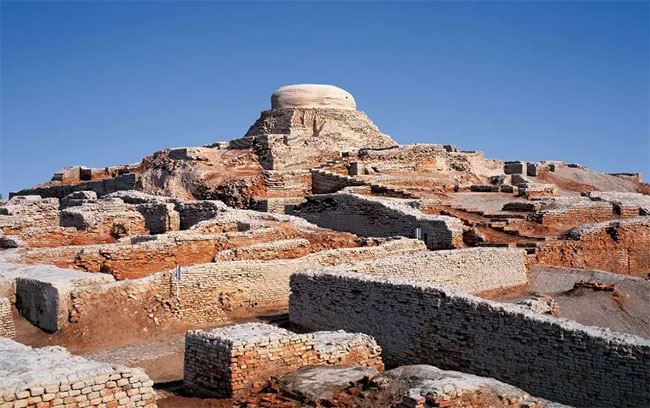
A distinctive feature of Mohenjo Daro is the uniformity of its city architecture.
The first natural disaster occurred in the famous Indus River region , a land now known as Pakistan and Western India, considered to be the earliest known urban culture of the Indian subcontinent . The site of this disaster is also known as “Mohenjo-daro.” At that time, an archaeologist discovered the remains of an ancient building in the area. After investigation and research, it was found that the building dated back to before 2600 BC. Mohenjo-daro is characterized by its uniform architecture, particularly in its water supply and sewage systems. However, archaeologists determined that the city had been completely buried in the mud of the Indus River 4,500 years prior. The city was built on an artificial platform made of brick, clay, and earth, believed to protect its inhabitants from floods and invasions.
Because archaeologists found that the city’s collapse was not an unnatural decline, but a sudden interruption, as if some natural disaster had occurred. Furthermore, there were several corpses inside. These corpses had various forms, and they seemed unaware of the disaster, as if they were preoccupied with their own affairs. When the sudden calamity struck, they didn’t have time to realize it and simply died silently, as if a pause button had been pressed abruptly, and all civilization was abruptly interrupted.
Many scientists were also extremely intrigued by such a situation, with some suggesting it was a sudden explosion that killed people instantly before they could escape. However, this claim needs verification, as before 2600 BC, there was no such thing as the gunpowder theory.
Others believe it was a natural disaster caused by astronomical phenomena, specifically lightning. Under the influence of various radiations in and outside of space, many black lightning bolts converged, generating high temperatures before exploding, simultaneously releasing toxic gases until they died.
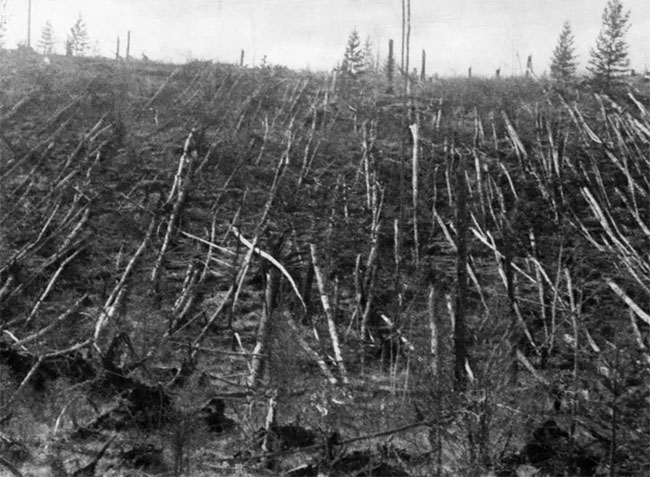
The explosion caused a fire that wiped out 80 million trees and countless animals across an area of more than 1,300 square kilometers.
Natural disasters occurred in southern Asia, and strange natural calamities also happened on the Tunguska River in Eastern Siberia (Russia) to the north. In 1908, a fireball exploded on the Tunguska River, and sparks immediately fell into the forest, causing a fierce fire. The flames wiped out 80 million trees and countless animals over an area of more than 1,300 km², the sky turned red, surrounding cities were also affected, the scene was terrifying, like the eruption of the Roman volcano Pompeii.
For natural disasters like this, people naturally make many speculations. At the time, the explosion’s destructive power was even greater than the atomic bombs dropped on Hiroshima and Nagasaki, so people suspected that the explosion on the Tunguska River was an atomic bomb.
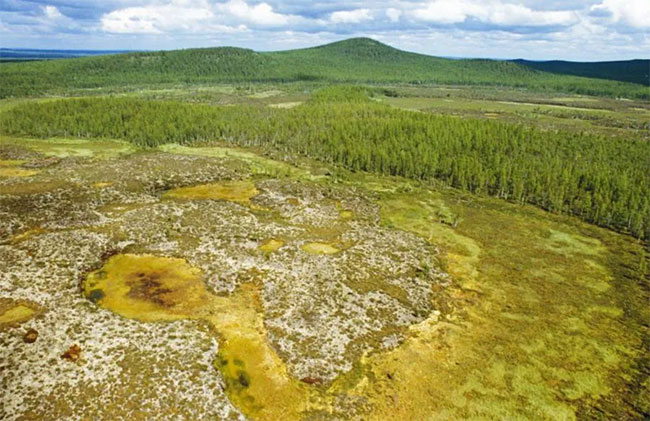
At the time, the explosion’s destructive power was even greater than that of the atomic bombs dropped on Hiroshima and Nagasaki.
However, this explosion occurred in 1908, when the world was still in the midst of the second industrial revolution, and technologies like the atomic bomb had only emerged in the third industrial revolution, so it may not have been an atomic bomb explosion. But the power was so immense that it is suspected that the explosion was caused by an asteroid impact at that time. However, the assumption that an asteroid impact is inevitable cannot be confirmed. Since there were no giant craters around the Tunguska River, its impact on Earth remains questionable. To this day, people are still pondering the true cause of the explosion.
The last strange natural disaster occurred during the Ming Dynasty in China. In 1632, there was suddenly a loud noise in the Wang Gong factory in the southwest corner of Beijing, then thick smoke appeared in the sky, and a mushroom cloud, resembling the explosion of an atomic or hydrogen bomb, rose up.
After the explosion, people began clearing the scene and recording preliminary figures. According to historical records from the Ming Dynasty, the explosion killed more than 20,000 people at the time, and its blast radius extended 13 miles. Although there was no war, it felt like war; the entire explosion area resembled a hellish furnace on earth.
Later, the emperor sent people to investigate, but to no avail. Of course, in this case, there were still some bold speculations, and some said it was a gunpowder explosion. But in the Ming Dynasty, even with the remarkable development of gunpowder manufacturing technology, the explosive power of gunpowder could not have been that great. Naturally, some still say it was a meteorite falling from the sky, but historical records do not mention it, and we have no way of knowing the truth of the situation, nor do we know if meteorites actually appeared. To this day, the cause of the explosion remains unexplained.
The world is vast and there is so much we don’t know, especially about natural disasters. What we know now is nothing more than volcanic eruptions, landslides, and other catastrophes, and we know the scientific principles, but there are some things that aren’t based on science. It’s difficult to explain clearly, especially given the time and space in between, whether it’s the sudden halt of civilization in Mohenjo-daro or the eruption of Tunguska… we have no way of knowing the real reason.
However, human potential is limitless; the dream of soaring through the sky, once only a fantasy, has now become a reality. Perhaps, at a certain level of technological development in the future, many unsolved mysteries of the past will be solved. However, until we find the answers, we cannot help but be amazed by these enigmas, and we must vigorously develop technology so that the true answers can emerge sooner.