



New data collected by NASA spacecraft could help space agencies move closer to establishing their first extraterrestrial base.
According to Sci-News , NASA’s Lunar Reconnaissance Orbiter (LRO) has discovered larger ice deposits than scientists had previously imagined in the “permanently dark region” around the Moon’s South Pole.
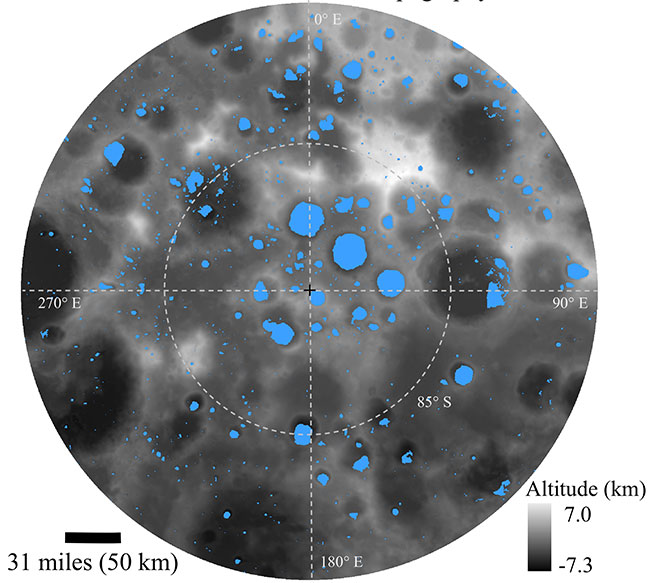
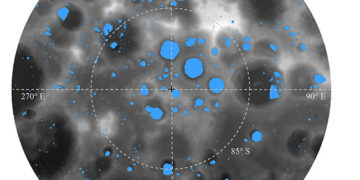
Images captured by NASA spacecraft show many areas of permanent shadow marked in blue – (Photo: NASA)
Permanent shadow regions (PSRs) typically appear in topographic depressions near the Moon’s poles, where sunlight can never reach.
Therefore, they have remained cold for billions of years, and this has helped preserve the ice molecules more than we thought, accumulating them into large deposits.
Dr. Timothy McClanahan, a researcher from NASA’s Goddard Space Flight Center, said their models and analysis show that the highest concentrations of ice are expected to appear near the coldest parts of the PSR, where temperatures drop to -198 degrees Celsius.
Those are the dark, sloping hills that lead southward.
They couldn’t pinpoint the exact volume of the PSR ice deposits or determine whether they were buried beneath dry rock, but they estimated that up to 5 liters of ice were contained in every 1 cubic meter of near-surface sediment.
This is just a preliminary discovery.
The NASA spacecraft LRO is carrying the Lunar Exploration Neutron Detector (LEND), an instrument that has helped scientists identify these ice deposits and will continue to help them learn more about the properties of what lies beneath the surface in the shadow regions.
The discovery of large ice deposits is good news for NASA as well as many other space agencies around the world.
Many space agencies have long desired to establish the first extraterrestrial base on the Moon, where the available water—from ice deposits—would serve as both a source of sustenance and contribute to the fuel for spacecraft and other equipment.