



The Chandra and XMM-Newton observatories have “picked up” something incredibly gruesome: the “zombie” fragments of a star 14 times the size of the Sun, scattered throughout the universe.
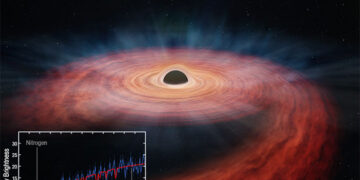
Chandra and XMM-Newton, the powerful X-ray observatories of NASA and ESA (the US and European space agencies), captured the terrifying moment of ASASSN-14li , the ill-fated victim recently identified as a monstrous black hole, according to Live Science.
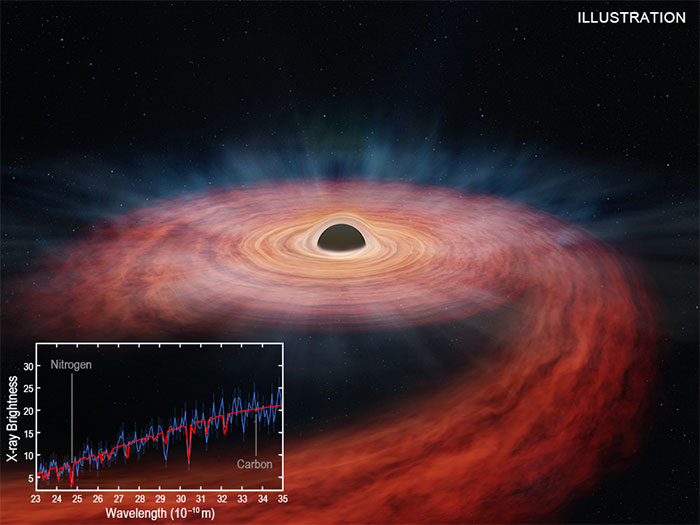
A portrait of the mysterious flare ASASSN-14li – (Image: NASA / CXC / University of Michigan / Miller et al. / M. Weiss).
Previously, ASASSN-14li erupted as a ghostly, eerie flame in 2014, recorded by Ohio State University’s ASASSN project, which involved 20 robotic telescopes.
At the time, scientists were baffled and couldn’t clearly identify what it was, but now the answer has been revealed.
“We’re seeing the nature of what used to be a star. The elements left behind are clues we can follow to figure out what kind of star died,” said Dr. Jon Miller from the University of Michigan, lead researcher on ASASSN-14li.
This event is valuable in two ways: firstly, scientists had the opportunity to almost witness firsthand one of the most dramatic black hole-tearing incidents ever, and secondly, the type of “victim” star this time is extremely rare.
It is also the most lavish “meal” a black hole has ever known to have.
Furthermore, the “zombie” fragments of that ill-fated star that scientists observed were not material ejected indiscriminately as is typically the case.
Two incredibly powerful observatories have inadvertently captured the “guts” of the star still trapped inside the black hole. In other words, they have looked inside the black hole.
The combined power of the black hole and the immense energy of the star creates a terrifying explosion, making it easier to observe.
This is also the closest black hole tearing apart a star to Earth captured in a decade, located in a galaxy 290 million light-years away from us, according to Sci-News.