



With the incredible advancements in technology, humanity has made tremendous strides in space exploration and reaching other planets. However, what happens inside the Earth remains a mystery.
Agartha and the “Hollow Earth” theory
Mythological tales of the Atlantean and Lemurian kingdoms have always fascinated many adventurers who enjoy exploring the world’s mysteries.
In addition, historians are also interested in certain documents about the world just below us, such as the “Underworld of Hades” in Greek mythology, especially the Agartha civilization .
Although often associated with esotericism and mythology, the concept of Agartha played a significant role in popularizing the “Hollow Earth” theory.
Agartha is described as a utopian city located in the Earth’s core, with a civilization nurtured by its own sun. Agartha is closely associated with Shamballa, a prominent feature in Vajrayana Buddhism, alongside the Tibetan Kalachakra teachings.
Existing theories about Agartha suggest that its inhabitants possessed extraordinary intelligence and a superior way of life compared to their counterparts on Earth.
Meanwhile, according to Hindu mythology, Agartha is the lost land of the Aryavartas , a superior race who fled into the vast caves and tunnels leading to their kingdom.
Furthermore, scriptures also indicate that Agartha may have been the dwelling place of the Nagas, a race of powerful and magical half-human, half-serpent deities who lived in the lowest level of the hollow earth, Patala .
One of the earliest concepts of a hollow Earth was put forward by Edmond Halley , the discoverer of Halley’s Comet. He proposed this theory in the 17th century, claiming that the Earth consists of several concentric crusts separated by individual atmospheres, with the outermost layer being approximately 800 km thick.
Furthermore, according to Halley, natural phenomena such as magnetic variance and the Aurora Borealis (Northern Lights) are caused by these layers, which move independently of each other. He presented this theory in 1692 based on measurements of magnetic fields and knowledge of the gravitational forces of the Sun and Moon on Earth.
Many people liked the idea, and the hollow Earth model presented by Edmond Halley was refined in the following years. The theory of multiple worlds separated by different atmospheres paved the way for a simpler view of the hollow Earth. According to this theory, each layer of the Earth has a sun at its center, nurturing a lush, habitable environment.
More than a century later, Halley’s theory was thoroughly explained by John Cleves Symmes , who published a paper expressing his intention to travel inside the Earth. He spent the rest of his life seeking support for this expedition.
He successfully persuaded Congress to vote on his proposal to fund his expedition. Although the idea was later rejected, Symmes’ enthusiasm remained undiminished. He continued to popularize the hollow Earth concept, giving speeches, writing articles, and engaging in debates until his death in 1829.
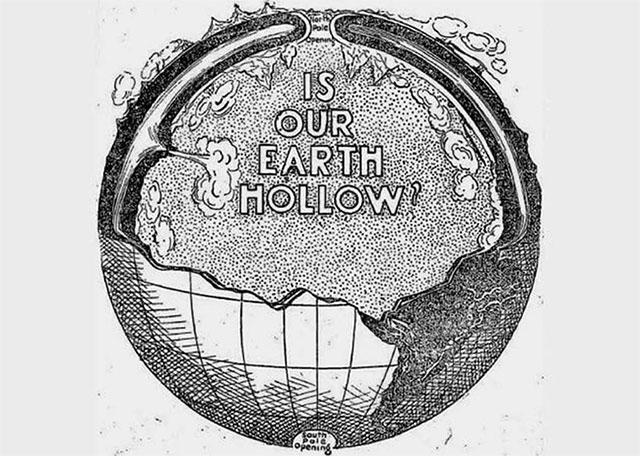
Is our Earth hollow?
Diary of Admiral Richard E. Byrd
Although the hollow Earth theory was widely supported, no one had actually made contact with the Agartha civilization until 1947, when the story of Admiral Richard E. Byrd of the U.S. Navy sparked curiosity about the type of people who lived underground.
According to an entry in his diary written during his flight to the poles, Byrd encountered a warm, lush climate with mammoth-like creatures and an ancient humanoid race that once inhabited Earth. His plane was manipulated mid-air and forced to land by beings from the center of the Earth.
Upon landing, he met with envoys from a civilization many believed to be the mythical Agartha civilization. They expressed concern about humanity’s use of the atomic bomb in World War II and sent Byrd as ambassador to return to the United States and convey their sentiments.
However, these details in Admiral Byrd’s diary are questionable, suggesting that he may never have reached the North Pole during his expeditions.
Regardless of the reliability of Admiral Byrd’s writings, it is important to note the similarities between his documents and descriptions of the ancient civilizations of Atlantis and Lemuria.
Even today, evidence of fossilized fish skeletons and coral reefs can be found in the arid regions north of the Himalayas, believed to have once been Shamballa or Shangri-La.
Although there is no concrete evidence to support the existence of civilizations more advanced than ours in the Earth’s core, the stories associated with them have generated much speculation.
Could there be a real, thriving kingdom right beneath us? Are they connected to our world? What will we do when we discover their existence and the knowledge they conceal? The quest for truth about the possibility of a civilization existing within a hollow Earth continues.