



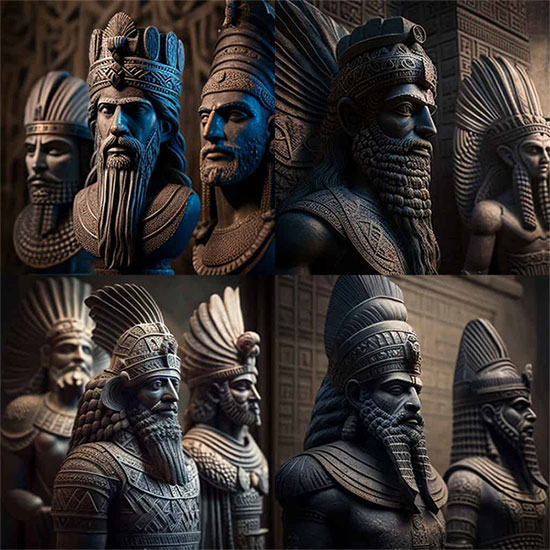
There are many myths and legends in human history, some of which speak of prehistoric giants. For example, the “god” Anunnaki in the Sumerian civilization.
Sumerian civilization is one of the earliest civilizations known to humankind, emerging around the fourth millennium BC in what is now southern Iraq.
The Sumerians left behind a vast number of cuneiform writings documenting their history, culture, religion, science, and other aspects. Most notable among these are their accounts of the origins of humankind and their myths and legends.
According to records from the Sumerian civilization, the Anunnaki were a type of advanced extraterrestrial being who, in order to repair their home planet, came to Earth to find the element gold and created humans to help them mine it.
Over time, the Anunnaki married humans, giving birth to hybrid children like Gilgamesh . Gilgamesh was different from ordinary humans; he was five meters tall, possessed unlimited strength, and had extraordinary intelligence. He once ruled Uruk, the largest and wealthiest city in Sumerian civilization.
These stories may sound absurd to the current understanding of humanity. However, the discovery of an ancient cemetery has proven that Gilgamesh may have actually existed .
“We found traces of what could be considered a tomb just outside the city of Uruk, in what used to be the bed of the Euphrates River,” Fassbinder said. “I don’t want to definitively say it’s the tomb of King Gilgamesh, but it looks very similar to the descriptions in the epic.”
In 2003, in southern Iraq, using sonar technology, an archaeological team led by German expert Jorg Fassbinder of the Munich Historical Museum discovered an ancient city in the desert , a city with a history of 5,000 years . Here, the team of archaeologists discovered not only gardens, houses, canals, and other facilities, but also a massive tomb.
The archaeological team recovered information from the sonar discovery that this ancient city is almost identical to Uruk in the records of the Sumerian civilization. Uruk was the earliest and most important city in the Sumerian civilization, where Gilgamesh once ruled.
With a diameter of over 5km, it could be considered the largest city in the world at that time. It had walls up to 10 meters high, as well as numerous temples and palaces. It also had a very advanced canal system that could irrigate agricultural land and served as a means of transportation. All of this shows that Uruk was once a very wealthy and developed city in the past.
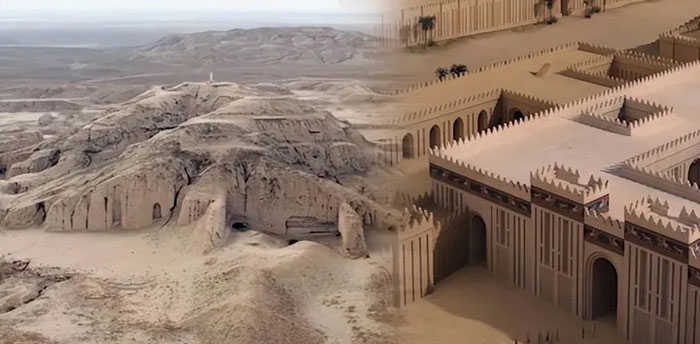
Over the more than 100 hectares excavated, the research team also identified structures of gardens, fields, and even houses of the Babylonians, similar to those described in the epic poem about Gilgamesh. However, the most astonishing discovery was an incredibly complex system of canals , “ like Venice in the desert,” Fassbinder remarked. This demonstrated the high level of development of the ancient inhabitants.
Furthermore, a statue of Gilgamesh was unearthed in the tomb, strangely enough, wearing an object resembling a watch on its hand and embracing a mature lion. This evidence suggests that this may have been Gilgamesh’s domain, and that he may have actually existed.
According to Sumerian records, Gilgamesh was the fifth king of Uruk listed in the Sumerian King List. He was considered the son of Lugarbanda and the daughter of the goddess Ningsong. He was also known as the “King of Heroes” for his extraordinary strength and courage.
In the epic, Gilgamesh is depicted as possessing two-thirds divine blood and one-third human blood, meaning he had the intelligence and strength of the gods, but not the longevity of the gods. Gilgamesh ruled cruelly towards his people, enslaving young people. Therefore, the people appealed to the gods for help, and the gods created Enkidu , a wild man, to confront and stop Gilgamesh’s cruelty. Enkidu came to Uruk and engaged in a fierce battle with Gilgamesh, ultimately becoming friends regardless of the outcome.
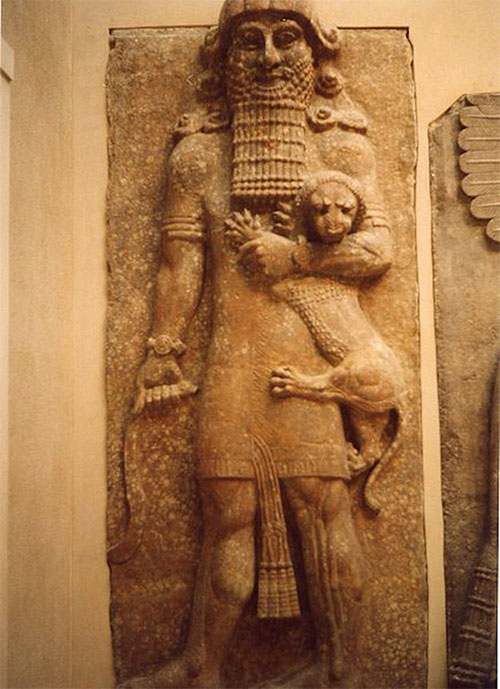
A statue of Gilgamesh was unearthed in the tomb; strangely, the statue wore an object resembling a watch on its hand and embraced a mature lion.
Since then, Gilgamesh changed his behavior, began to care for his people, and embarked on adventures with Enkidu, defeating many monsters and enemies. He also sought the secrets of immortality and left behind a “book of wisdom.” If these stories are true, then Gilgamesh was not just a mythological figure, but a real giant.
If this is true, the tomb would not only be an archaeological discovery but could also change our understanding of human history and origins. Because, according to records from the Sumerian civilization, the Anunnaki were a type of advanced being from outside Earth.
If these stories are true, then humanity is not the result of natural evolution, but rather an experiment by extraterrestrial beings. And Gilgamesh may possess strength and intelligence far beyond that of humans. He may have discovered a way to live forever and may have mastered advanced technology. These are things that inspire immense curiosity and a desire to explore.
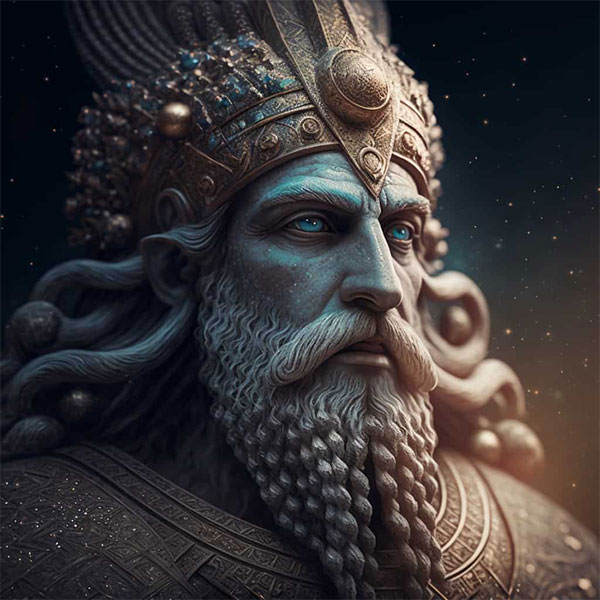
Two thousand years before the birth of Christ, Emperor Gilgamesh, ruler of Uruk, became the central figure in the Epic of Gilgamesh – considered the oldest “book” in history, but which is actually just a collection of inscribed clay tablets. According to this epic, Gilgamesh was buried in a tomb beneath the Euphrates River. However, after his death, the river changed course.
Unfortunately, not long after archaeologists discovered this ancient tomb, war broke out in the Middle East. The area was sealed off, prohibiting locals and journalists from entering. Therefore, the mystery of this area remains unsolved, and all the rumors circulating are unproven hypotheses.